Types of Caching in Programming and How to Choose the Right One for Your Needs
The type of caching to be used depends on the specific use case and the type of data being cached. In-memory caching is typically the fastest option but has limited storage capacity, while file and network caching can handle larger amounts of data but may be slower. Developers need to consider factors such as data size, access patterns, and data volatility to determine which caching strategy to use. There are several types of caching used in programming, including:
In-memory caching: This involves storing data in the computer's RAM, which is faster than accessing data from disk or network storage. In-memory caching is commonly used for storing frequently accessed data, such as session data or configuration settings.
File caching: This involves storing data on disk, which can be faster than fetching data from a remote source. File caching is often used for storing frequently accessed files, such as images or templates.
Network caching: This involves storing data on a remote server or CDN (Content Delivery Network), which can be faster than fetching data from the original source. Network caching is often used for storing frequently accessed data, such as API responses or static assets.
Top In-Memory Caching Solutions for Java Developers: Use Cases and Benefits
When choosing an in-memory caching solution for a Java application, developers should consider factors such as data size, access patterns, concurrency, and fault tolerance. Ehcache is a good choice for simple caching needs, while Hazelcast is suitable for large-scale distributed caching. Caffeine is ideal for high-concurrency and low-latency caching requirements. Ultimately, the choice of caching solution depends on the specific needs of the application and the performance requirements. There are several popular in-memory caching solutions available for Java developers, each with its own strengths and use cases. Here are some of the best options:
Ehcache: Ehcache is a widely-used, open-source caching framework for Java applications. It provides a simple and flexible API for developers to implement caching in their applications. Ehcache is often used for caching frequently accessed data, such as session data or configuration settings. It supports a wide range of caching options, including in-memory, disk-based, and distributed caching.
Hazelcast: Hazelcast is a distributed in-memory caching solution that supports Java and other programming languages. It provides high availability, scalability, and fault-tolerance. Hazelcast is often used for caching large datasets that need to be accessed quickly, such as real-time analytics or financial data. It is also suitable for applications that require distributed caching across multiple nodes.
Caffeine: Caffeine is a high-performance, lightweight caching library for Java 8 and above. It provides an efficient in-memory cache that is designed for high concurrency and low latency. Caffeine is often used for caching frequently accessed data, such as HTTP responses or database query results. It supports a variety of caching options, including time-based expiration, maximum size-based eviction, and customized cache loading.
Resolving Common Issues with In-Memory Cache: Tips and Strategies
In-memory cache can provide a significant performance boost to applications, but there are some common issues that can arise when using this type of caching:
Limited Capacity: In-memory cache has limited storage capacity, which can lead to cache evictions and reduced performance when the cache is full. To address this issue, applications can use a combination of in-memory and disk-based caching or use a distributed cache that provides more storage capacity.
Data Inconsistency: In-memory cache can lead to data inconsistency if multiple instances of the application are running or if the cache is not updated properly. To address this issue, applications can use a distributed cache that provides data consistency across multiple instances of the application.
Cache Invalidations: In-memory cache can also cause cache invalidations when data in the database is updated. To address this issue, applications can use a cache invalidation mechanism that updates the cache when data in the database changes.
High Memory Usage: In-memory cache can consume a lot of memory, which can lead to increased costs and reduced performance. To address this issue, applications can use memory-efficient data structures, such as compressed bitmaps or Bloom filters, or use a distributed cache that provides more memory-efficient storage.
What are the Best Alternatives to In-Memory Cache?
The choice of alternative to in-memory cache depends on the specific needs of the application, including the size of the data, the speed of access required, and the need for scalability and fault tolerance. Different caching solutions may be suitable for different scenarios.
Disk-Based Cache: Instead of storing data in memory, a disk-based cache stores data on the disk, which can provide more storage capacity compared to in-memory cache. However, it can be slower than in-memory cache due to the slower read and write speed of disk storage.
Distributed Cache: A distributed cache, such as Redis Cache or Hazelcast, stores data across multiple servers, allowing multiple instances of an application to share the same cache. This provides more scalability and fault tolerance than in-memory cache.
NoSQL Databases: NoSQL databases, such as MongoDB or Cassandra, provide high-speed data access by storing data in memory, but they can also store data on disk for persistence. These databases provide more storage capacity and scalability compared to in-memory cache.
Content Delivery Networks (CDNs): CDNs are a network of geographically distributed servers that cache and serve content to users based on their location. This can provide fast access to frequently accessed data, such as images or videos, and reduce the load on the application server.
Distributed Cache vs In-Memory Cache: Which is the Best for Your Application?
Distributed cache and in-memory cache are two different caching solutions used in modern applications, and they have some differences in their features and use cases. In-memory cache is a caching solution that stores data in the memory of the application server. It is designed to provide fast access to frequently used data by keeping it in memory, rather than retrieving it from a database or other data source each time it is needed. In-memory cache is often used to improve the performance of applications by reducing the number of database calls and increasing the speed of data access. Distributed cache, on the other hand, is a caching solution that stores data across multiple servers, allowing multiple instances of an application to share the same cache. Distributed caching is often used in large-scale applications where there are many instances running on multiple machines or in a cloud environment. It can help improve scalability and fault tolerance by spreading the load across multiple servers and reducing the risk of a single point of failure. In summary, in-memory cache is ideal for small to medium-sized applications where data can be cached on a single server, while distributed cache is better suited for large-scale applications that require caching across multiple servers for scalability and fault tolerance. The choice of caching solution depends on the specific needs of the application, the scale of the application, and the performance requirements.
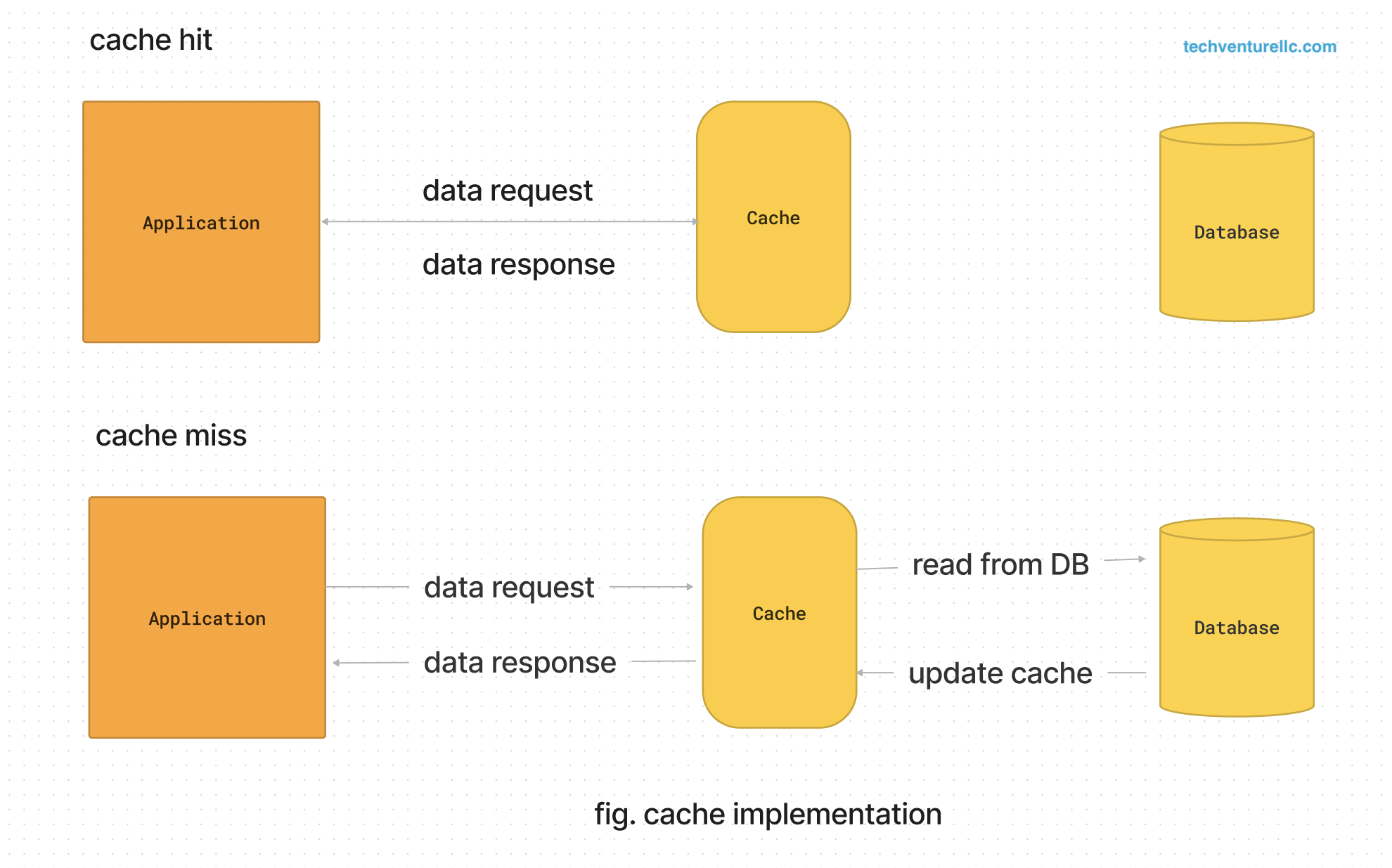
Example of In-Memory Cache: Suppose you have an e-commerce website that displays a list of products on the homepage. The list of products is stored in a database, and each time a user visits the homepage, the application retrieves the list from the database. However, since the list of products does not change frequently, it would be more efficient to store it in the memory of the application server as an in-memory cache. This would reduce the number of database calls and increase the speed of data access. Another example of in-memory cache is the caching of frequently accessed data, such as user session data, in-memory to reduce database calls.
Example of Distributed Cache: Suppose you have a high-traffic website that is hosted on multiple servers to handle the load. You need to maintain consistency of data across all servers, but accessing the database for every request is not feasible due to the high volume of requests. In this case, a distributed cache, such as Redis Cache, can be used to store the frequently accessed data across multiple servers. Another example of distributed cache is caching of web content across multiple servers in a content delivery network (CDN), where the cached content is stored across geographically distributed servers for faster access by users.
Best Distributed Caching Solutions: Use Cases and Cost-Effective Options
When it comes to distributed caching solutions, there are many options available with varying features and costs. Here are some popular options with their use cases:
Apache Ignite: Apache Ignite is an in-memory data grid that provides high-performance caching and processing capabilities. It's ideal for applications that require real-time data processing, such as financial trading systems and e-commerce platforms. Apache Ignite is a powerful and feature-rich solution, but it can be complex to set up and manage.
Redis: Redis is an open-source, in-memory data structure store that can be used as a distributed cache. It's easy to set up and provides high performance and scalability, making it a popular choice for applications that require low latency and high throughput, such as social networks and gaming platforms. Redis also provides support for various data structures such as lists, sets, and hashes, making it flexible for various use cases.
Memcached: Memcached is an open-source, high-performance, distributed memory object caching system. It's designed to cache data in memory to reduce the need to fetch data from the database. Memcached is commonly used in web applications to store session data, user profiles, and other frequently accessed data.
Hazelcast: Hazelcast is an open-source, in-memory data grid that provides distributed caching and processing capabilities. It's ideal for applications that require low latency and high throughput, such as real-time analytics and machine learning platforms. Hazelcast also provides support for distributed data structures such as maps and queues, making it flexible for various use cases.
Couchbase: Couchbase is an open-source, distributed NoSQL document database that provides a built-in caching layer. It's ideal for applications that require low latency and high scalability, such as mobile and web applications. Couchbase also provides support for full-text search, query, and event-driven architecture, making it a flexible solution.
Understanding Caching in Programming: Why It's Essential for Improved Performance
Caching is a temporary storage area used in computing to hold frequently accessed data. It helps optimize computer system performance by reducing the time needed to access data by avoiding recomputing or fetching from slower sources. In programming, caching is commonly used to store the results of expensive operations, such as database queries, so they can be quickly retrieved when needed again. Caching can be implemented in various ways, including in-memory caching, file caching, and network caching. By reducing the time needed to access frequently used data, caching can significantly improve the performance of applications.